


 PLATFORM UPDATE:


Nudging cell migration from within through microrod-induced morphological deformation

Abstract
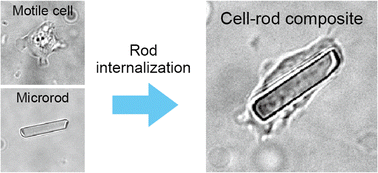
Cell migration plays a central role in various biological processes, including development, wound healing, and cancer metastasis, and represents a fundamental form of self-organized motion at the cellular scale. These self-propelled cells can serve as microscale agents with potential applications in bioengineering and microsystem design. To realize such possibilities, it is essential to establish effective methods for controlling their migration. Conventional approaches, such as chemotactic, optogenetic, and substrate-based guidance, depend on external interventions that influence only a limited number of cells. Here, we present a proof-of-concept in Dictyostelium discoideum to bias cell migration by inducing deformation from within the cell. We demonstrate that glass microrods are internalized and that these internalized rods elongate the cells along their own axis. The elongated cells tend to migrate in the direction of their long axis, resulting in enhanced directional persistence. Unlike conventional methods requiring external deterministic cues or patterned environments, our approach enables cells to autonomously and persistently alter their migration behavior through internal morphological deformation. This study introduces a new framework for modulating cell migration and establishes a foundation for developing biohybrid systems that utilize living cells as self-propelled carriers.
- This article is part of the themed collection: Soft Matter Open Access Spotlight 2026
 Please wait while we load your content...


