


 PLATFORM UPDATE:


Colloidal rod dynamics under large amplitude oscillatory extensional flow
 a
Vincenzo
Calabrese,
ab
Amy Q.
Shen,
a
Giovanniantonio
Natale
c
and
Simon J.
Haward
*a
a
Vincenzo
Calabrese,
ab
Amy Q.
Shen,
a
Giovanniantonio
Natale
c
and
Simon J.
Haward
*a
Abstract
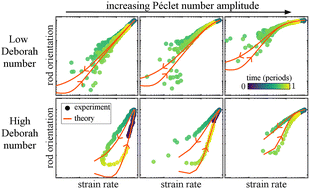
We perform a combined experimental and theoretical investigation of the orientational dynamics of colloidal rods subjected to time-dependent homogeneous planar elongational flow. Our experimental approach involves the flow of dilute suspensions of cellulose nanocrystals (CNC) within a cross-slot-type microfluidic device through which the extension rate is modulated sinusoidally over a wide range of Péclet number amplitudes (Pe0) and Deborah numbers (De). The time-dependent orientation of the CNC is assessed via quantitative flow-induced birefringence measurements. For small Pe0 ≲ 1 and small De ≲ 0.03, the birefringence response is sinusoidal and in phase with the strain rate. With increasing Pe0, the response becomes non-sinusoidal (i.e., nonlinear) as the birefringence saturates due to the high degree of particle alignment at higher strain rates during the cycle. With increasing De, the CNC rods have insufficient time to respond to the rapidly changing strain rate, leading to asymmetry in the birefringence response around the minima and a residual effect as the strain rate approaches zero. These dynamical responses of the CNC are captured in a detailed series of Lissajous plots of the birefringence versus the strain rate. Experimental measurements are compared with simulations performed on both monodisperse and polydisperse systems, with rotational diffusion coefficients Dr matched to the CNC. A semiquantitative agreement is found for polydisperse simulations with Dr heavily weighted to the longest rods in the measured CNC distribution. The results will be valuable for understanding, predicting and optimizing the orientation of rod-like colloids during transient processing flows such as fiber spinning and film casting.
- This article is part of the themed collections: Soft Matter 20th Anniversary Collection and Soft Matter Open Access Spotlight 2026
 Please wait while we load your content...


