


 PLATFORM UPDATE:


Impact of slipping plane location and ion-partitioning on the diffusiophoresis of soft particles with hydrophobic inner core
 *a
*a
Abstract
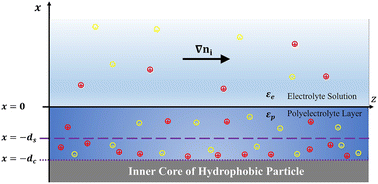
We examine the diffusiophoresis of core–shell structured soft particles, focusing on a structural model relevant to many biological and environmental systems. This model features a rigid hydrophobic inner core enclosed by a shell that is penetrable to both ions and fluid. A key novelty of this approach is assuming the slipping plane resides within the polyelectrolyte layer (PEL), rather than being fixed precisely at the core–shell interface, reflecting more complex internal hydrodynamics. This study assumes the shell layer possesses a dielectric permittivity lower than that of the bulk electrolytic solution. Such a situation is frequently encountered and relevant in the analysis of both biological and environmental colloids. As a result, the ion partitioning effect is operational across the PEL, which is however directly related to the penetration of mobile electrolyte ions across the PEL and controls its net volumetric charge. Thus, we model the diffusiophoresis of soft particles by integrating several crucial physical mechanisms: a hydrophobic and charged inner core, a slipping plane located within the surface PEL, the volume charge of the PEL, and the ion partitioning effect. The analysis is conducted within the flat-plate regime and the Debye–Hückel electrostatic framework. Based on these assumptions, we have derived a general expression for the diffusiophoretic velocity of the undertaken soft particle, which is applicable when the particle is exposed to a concentration gradient of valence-symmetric electrolytes with equal or unequal ionic diffusivities. We further illustrate the results to indicate the impact of the pertinent parameters.
 Please wait while we load your content...


