


 PLATFORM UPDATE:


Probing and modeling cell–cell communication in 2D biomimetic tissues

Abstract
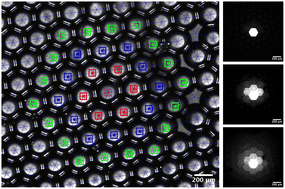
In tissues, cells in direct physical contact with each other can exchange ions or molecules via protein clusters called gap junctions, that form channels across the membranes of adjacent cells. Here, we use a simplified biomimetic approach, coupled with theoretical modeling, to unravel the physical mechanisms controlling such transport. Tissues are mimicked with 2D hexagonal networks of monodisperse aqueous droplets connected by lipid membranes called droplet interface bilayers (DIBs) decorated with α-hemolysin (αHL) transmembrane proteins forming nanopores through heptamerization in the membrane. The diffusion of calcein across 2D DIB networks is thoroughly studied using epifluorescence microscopy at various αHL concentrations. The results are successfully reproduced with a continuous time random walk model in hexagonal networks with an average waiting time increasing nonlinearly with the concentration of pore monomers.
 Please wait while we load your content...


