


 PLATFORM UPDATE:


Distinguishing liquid crystalline nematic variants by machine learning

Abstract
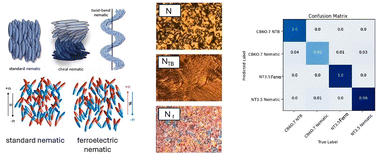
Two different machine learning architectures – sequential convolutional neural networks (CNN) and parallel inception models were evaluated with respect to their ability to identify nematic liquid crystal variants, including the ferroelectric and the twist-bend nematic phases. Varying levels of model complexity were employed from 1- to 5-layer CNNs, to 1- to 3-block inception models. Various types of augmentations like flip, contrast and brightness were used, together with dropout-layer regularisation. Flip was the only augmentation trialled to yield positive results with an acceptable level of accuracy and error, while the inclusion of dropout regularisation almost exclusively led to lower accuracies. From the systematic investigation it is advised that different variants of the nematic phase can be distinguished to an accuracy better than 0.96–0.98 ± 0.01 by the use of 3-layer CNNs or a model with a single inception block, if flip augmentation is applied. Computational restraints therefore suggest that a sequential CNN is sufficient to characterise phase sequences with four or fewer different phases. Higher accuracies, closer to 100%, can be achieved for extended and class-balanced datasets. In the latter case an inception approach would possibly be beneficial, depending on the size of the dataset, but overfitting needs to be avoided.
- This article is part of the themed collections: Liquid Crystals and Soft Matter Open Access Spotlight 2025
 Please wait while we load your content...


