


 PLATFORM UPDATE:


Lipstick structure revealed by multimodal strain- and time-dependent rheology

Abstract
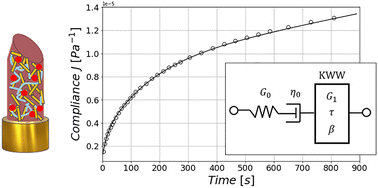
Since their earliest developments, lipsticks have been heterogeneous wax/oil-based cosmetics enriched with pigments and nacres. Originally made from basic constituents, formulations have substantially evolved, now incorporating a variety of advanced components such as polymers, silicones, and fillers, as consumers have become more and more demanding about product performance. This evolution has made the mechanisms underlying macroscopic properties of lipsticks increasingly complex. Understanding their mechanical behavior under stress has therefore become important for formulation design and product performance optimization. In this study, the elastic properties as well as linear and non-linear viscoelastic properties of three grades of commercially available lipsticks are explored through compression experiments and rheological shear and oscillatory measurements. A model based on the Kohlrausch–Williams–Watts (KWW) function is proposed to describe the creep behavior in the linear viscoelastic regime. At large deformations, lipsticks exhibited intracycle strain-stiffening and shear-thinning nonlinearities leading to structural breakdown, as revealed by Lissajous–Bowditch plots and Fourier analysis, while microcracking eventually occurred under compression. This work shows that, although the studied lipsticks exhibit distinct macroscopic properties reflecting different material textures, they all seem to follow the same constitutive law within the linear range. Two relaxation regimes are identified, with a crossover at about 10 seconds separating short- and long-timescale responses. Moreover, the identification of a continuous spectrum of relaxation mechanisms by strain- and time-dependent rheological experiments points to an intertwined architecture that likely underlies the mechanical stability of lipsticks.
- This article is part of the themed collection: Soft Matter Open Access Spotlight 2026
 Please wait while we load your content...


