


 PLATFORM UPDATE:


Nonlinear elasticity and transition to macroscopic irreversibility in composite hydrogels

Abstract
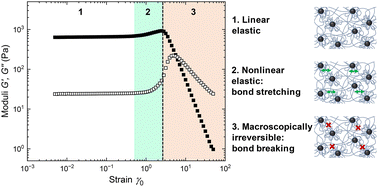
Filler-hydrogel composites combine enhanced mechanical properties with functionalities conferred by the nanofillers. When the nanofillers interact attractively with the hydrogel matrix, even low nanofiller volume fractions can lead to a strong increase in the linear viscoelastic moduli. Here, we build on our understanding of the microscopic phenomena at play in these systems to explore their nonlinear response, using attractive nanofillers embedded in a gelatin matrix. We identify a critical deformation beyond which the material no longer recovers its macroscopic viscoelastic properties, marking the onset of macroscopic irreversibility. Increasing nanofiller volume fraction leads to nanofiller-induced stiffening of the polymer matrix, yet the overall viscoelastic response of the composites remains qualitatively similar to that of pure hydrogels: under increasing strain amplitude, their elastic and viscous moduli, G′ and G″, exhibit a pronounced overshoot followed by a crossover associated with yielding. A transition occurs in the composite at the strain amplitude  where G′ reaches its maximum, characterized by a marked change in the stress relaxation dynamics. Beyond
  , the composites no longer recover their initial viscoelastic properties in repeated strain amplitude sweeps, indicating that the material has sustained macroscopically irreversible changes and a permanent loss of elasticity. We thus identify three distinct regimes in the strain-stiffening materials: nonlinear elasticity, macroscopic irreversibility, and yielding. We further suggest that the plasticity underpinning macroscopic irreversibility is due to the breaking of bonds that contribute most to the composite's strain stiffening response in the hydrogel matrix.
- This article is part of the themed collection: Soft Matter Open Access Spotlight 2026
 Please wait while we load your content...


