


 PLATFORM UPDATE:


Bridging scales: machine learning for the rational design and modelling of shape memory polymers
 a
and
Giulia
Scalet
*b
a
and
Giulia
Scalet
*b
Abstract
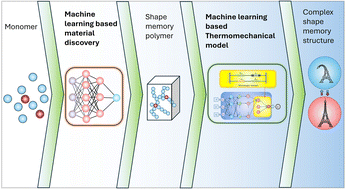
Shape memory polymers (SMPs) are a class of stimuli-responsive materials with significant potential across diverse fields including soft robotics, biomedical devices, and mechanical engineering. To realize a scale transition from small molecules to a mechanical structure with excellent SMP behaviour, investigators typically need both material design and constitutive model establishment. Traditionally, the design of SMPs relies on empirical methods, limiting the speed of discovery and property tuning. Moreover, the prediction of their behaviour generally depends on theoretical and numerical tools that, however, require an in-depth understanding of theoretical mechanics. In contrast, machine learning (ML) offers a powerful tool to possibly overcome these limitations and has increasingly drawn attention from investigators in multiple fields. In this perspective, we critically review recent advances in the application of ML techniques to SMPs. We discuss major conventional concepts in the field of SMPs, basic procedures and important approaches to ensure ML-assisted SMP design, how different ML tools have been employed to identify new SMP chemistries and to predict their thermo-mechanical and shape memory properties. Despite these successful advancements, ML-assisted SMP discovery and thermo-mechanical modelling remain at an early stage. We discuss how they are limited, e.g., by incomplete structural representations and challenges in integrating thermal and temporal effects into the neural network. Finally, we outline future directions to explore and implement, including developing tools to capture complex SMP topologies and creating polymer-specific neural networks. The discussion allows us to provide new insights into the use of ML tools for the world of SMPs.
- This article is part of the themed collection: Soft Matter Open Access Spotlight 2025
 Please wait while we load your content...


