


 PLATFORM UPDATE:


Glassy dynamics in two-dimensional ring polymers: size versus stiffness polydispersity
 *ab
and
Satyavani
Vemparala
*ab
*ab
and
Satyavani
Vemparala
*ab
Abstract
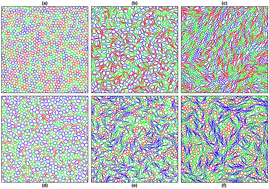
Soft glassy materials often consist of deformable objects. Here, we use a two-dimensional assembly of semi-flexible ring polymers as a model system to investigate how polydispersity in particle stiffness or size influences the onset of glassy dynamics. In simulations at fixed polydispersity (30%), we find that stiffness dispersity drives most rings into elongated conformations at high densities, leading to orientationally ordered structures that cause dynamical slowing down. In contrast, size dispersity generates a bimodal population: small rings remain circular and act as rigid inclusions, while large rings elongate, producing frustration that delays arrest. Real-space maps of bond relaxation reveal strikingly different pathways of dynamical heterogeneity, with long-lived domains persisting under stiffness dispersity but rapidly percolating relaxation under size dispersity. Moreover, local correlations between ring shape, orientational order, and mobility show that stiffness dispersity produces dynamics that are strongly structure-sensitive, whereas size dispersity activates motion from both circular and elongated populations. By linking microscopic deformability to emergent glassy dynamics, this study identifies how the nature of polydispersity controls the relaxation pathways of soft glasses.
 Please wait while we load your content...


