


 PLATFORM UPDATE:


Epoxy coating to prolong actuation time in degas-driven PDMS micropumps

Abstract
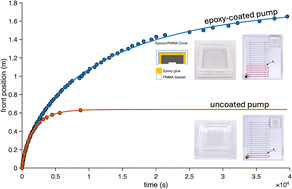
To enhance the portability of Lab-on-a-Chip technology, avoiding bulky electronic flow control systems is crucial. Self-powered microfluidics can significantly improve portability by eliminating the need for electronic components. Traditionally, self-powered microsystems handle small fluid volumes for up to one or two hours. However, many experiments, such as cell culture or real-time biomarker detection assays, require flow control for longer periods. In this study, we demonstrate that polymeric micropumps can provide self-powered flow control for intermediate durations, ranging from several to more than 10 hours. By monitoring the fluid front dynamics of a solution flowing through a microchannel over 1.5 meters long, we developed calibration curves for various micropump types. Our findings reveal that the pump's actuation time is influenced by degassing time, and effective surface area. Using these calibration curves, we compare mathematical models to predict flow rates and actuation times, facilitating the design of customized self-powered microsystems for both short and long-term applications. Epoxy-coated PDMS pumps represent a notable example of a long-operating self-powered microsystem, which holds significant potential for applications requiring controlled flow over extended periods.
- This article is part of the themed collection: Soft Matter Open Access Spotlight 2026
 Please wait while we load your content...


