


 PLATFORM UPDATE:


Differing growth dynamics in seed-grown planar vertical chemical gardens

Abstract
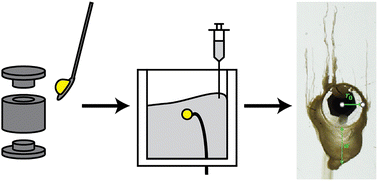
Chemical gardens are self-assembled structures of semi-permeable precipitates. They are considered laboratory analogues of hydrothermal vents and can potentially be used for functional chemobrionic materials. In this work, the behaviour of chemical gardens grown from magnesium chloride seeds in sodium silicate solutions in a vertical Hele-Shaw cell has been investigated. The chemical gardens exhibited non-isotropic radial growth - fastest at the bottom and slowest at the top. In each direction, the radial growth can be modelled by a diffusion-controlled law. The relative pressure at the centre of the chemical garden underwent an initial, gradual growth, followed by a rapid increase that turned into a plateau. Upward tubular growth was observed for higher silicate concentrations, and the onset of upward tubular growth has been found to correlate with the onset of rapid pressurisation. The results may have implications on the formation mechanisms of hydrothermal vent flanges.
- This article is part of the themed collection: Soft Matter Open Access Spotlight 2026
 Please wait while we load your content...


