


 PLATFORM UPDATE:


Synthesis of tough and fluorescent hydrogels via the synergistic associations of tetraphenylethane fluorogens and polymethylene spacers
 a
Zi Liang
Wu
*a
a
Zi Liang
Wu
*a
Abstract
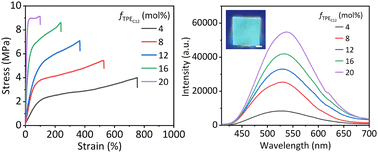
Incorporating hydrophobic associations into hydrophilic networks as energy dissipation units is an efficient strategy to toughen hydrogels. However, the micro-segregated structures often lead to turbid hydrogels with poor optical properties. Here, we report the synthesis of transparent, tough, and fluorescent hydrogels in which tetraphenylethylene (TPE) fluorogens are linked to the network by a polymethylene spacer. The TPE motif and polymethylene spacer form hydrophobic associations, affording the transparent hydrogels with excellent mechanical properties and strong fluorescence. The mechanical properties of the hydrogels can be tuned by the fraction of hydrophobic units, the length of the polymethylene spacer, and the presence of the TPE motif. A rubbery-to-glassy transition is found in poly(12-(4-(1,2,2-triphenylvinyl)phenoxy)dodecyl acrylate-co-acrylic acid) hydrogels and poly(4-(1,2,2-triphenylvinyl)phenoxy)hexyl acrylate-co-acrylic acid) hydrogels as the fraction of hydrophobic units increases. The increased glass transition temperatures and apparent activation energies of the hydrogels with longer spacers and the TPE motif indicate a synergistic effect between the hydrophobic polymethylene and TPE motifs. Small- and wide-angle X-ray scattering results show that these tough and fluorescent hydrogels have compact hydrophobic domains with a quasi-lamellar structure. The hydrophobic domains are disrupted during stretching to dissipate energy, accounting for the high toughness of the hydrogels. This study presents a novel strategy to construct tough and fluorescent hydrogels by forming synergistic associations, which should be informative for designing other tough materials with specific functions and applications.
 Please wait while we load your content...


