


 PLATFORM UPDATE:


Viscoelastic properties of tumor spheroids revealed by a microfluidic compression device and a modified power law model
 a
Bangguo
Zhu,
c
Kaitlyn
Roach,
b
Young Joon
Suh,
a
Chung-Yuen
Hui
c
and
Mingming
Wu
*a
a
Bangguo
Zhu,
c
Kaitlyn
Roach,
b
Young Joon
Suh,
a
Chung-Yuen
Hui
c
and
Mingming
Wu
*a
Abstract
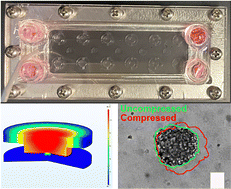
Clinically, palpation is one of the important diagnostic methods to assess tumor malignancy. In laboratory research, it is well accepted that the bulk stiffness of the tumor and the surrounding tissue is closely correlated with the malignant state of the tumor. Here, we postulate that, in addition to tumor stiffness, tumor viscoelasticity – the fact that tumor tissue takes time to bounce back after compression, can also be used to evaluate the tumor malignancy state. In this work, we characterized the viscoelastic properties of tumor spheroids using a recently developed microfluidic compression device by quantifying their relaxation dynamics upon load removal. Tumor spheroids were made using breast tumor cells spanning various malignancy levels; non-tumorigenic epithelial (MCF10A), moderately malignant tumor (MCF7) and triple negative metastatic tumor (MDA-MB-231) cell line. Spheroids embedded within a 3D extracellular matrix were periodically compressed, and their strain responses were recorded using microscopic imaging. Our results revealed that the measured strain relaxation dynamics can be successfully described by a modified power law model, demonstrated that non-tumorigenic tumor spheroids were more elastic, exhibited shorter relaxation time and less plasticity than those of tumorigenic spheroids. This work highlights that viscoelastic properties in addition to bulk stiffness of the tumor spheroids can serve as a complementary mechanical biomarker of tumor malignancy and demonstrate the validity of a modified power law model for the mechanical characterization of a living tissue.
- This article is part of the themed collection: Soft Matter Open Access Spotlight 2026
 Please wait while we load your content...


