


 PLATFORM UPDATE:


Shape spectra of elastic shells with surface-adsorbed semiflexible polymers

Abstract
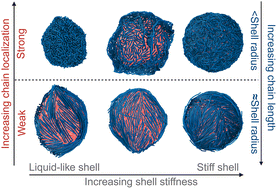
The shape of biological shells, such as cell nuclei, membranes, and lipid vesicles, often deviates from a perfect sphere due to an interplay of complex interactions with a myriad of molecular structures. In particular, semiflexible biopolymers adsorbed to the surfaces of such shells seem to affect their morphological properties. While the effect of a single, long, semiflexible chain is relatively well characterized, the mechanisms by which a high density of such surface-adsorbed polymers can alter the morphology of a spherical, soft confinement, akin to biological shells, remain relatively poorly understood. Here, we use coarse-grained molecular dynamics to explore how surface adsorption of many semiflexible polymers affects the morphology of a pressurized bead-spring network shell, which is spherical in the absence of these polymers. By varying the attraction strength between the semiflexible chains and the shell surface, chain concentration, and the polymerization degree of chains, we demonstrate that strong surface localization of the chains can induce shape distortions and decreased shell size. Conversely, weak localization does not induce significant shape fluctuations, yet nematically ordered phases appear on the surface. Notably, these ordered phases lead to elliptic shell shapes for chains with sizes comparable to or longer than the radius of the confinement when the elastic shell is composed of extensible, harmonic bonds, which may emulate a liquid-like structure. Overall, our findings offer a strategy to control the morphology of synthetic shells by manipulating peripheral localization and length of semiflexible polymers while suggesting a mechanism for non-spherical shapes appearing in some biological systems.
 Please wait while we load your content...


