


 PLATFORM UPDATE:


Electro-magneto-kinetic thermo-fluid–structure interactions of viscoelastic electrolytes through soft micro-confinements

Abstract
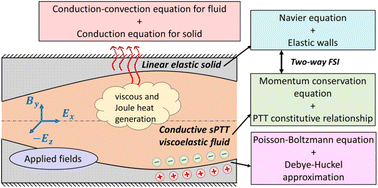
A coupled electro-magneto-hydrodynamic (EMHD) framework for a viscoelastic electrolyte (of Phan–Thien–Tanner (PTT) fluid rheology) flowing through a compliant micro-confinement with linearly elastic walls is developed. The flow is driven by a combination of an imposed pressure gradient and externally applied electric and magnetic fields. Closed-form perturbation solutions are obtained for the velocity, pressure, wall deformation, and temperature. Fluid–structure interactions (FSI) are examined against four parameters: Debye–Huckel parameter (![[small kappa, Greek, macron]](https://www.rsc.org/images/entities/i_char_e0cb.gif) ), Weissenberg number (Wi), Hartmann number (Ha), and electrical Reynolds number (S). We show that favourable pressure gradients drive wall contractions towards a converging channel, while adverse gradients cause wall expansion to a diverging geometry. Observations also show that reduces the pressure requirement through electroosmotic pumping; Wi induces shear-thinning that flattens velocity profiles; Ha has a dual effect – assistive at low Ha and resistive at higher Ha due to Lorentz drag; and S is consistently assistive, lowering the required pressure drop and enhancing near-wall transport. Thermal behaviour is characterized using three parameters—the Biot number (Bi), the Peclet number (Pe), and the wall-to-fluid conductivity ratio (kr): higher Bi improves cooling via wall–environment exchange, larger Pe increases axial thermal advection and raises fluid temperature, and higher kr facilitates heat removal and limits thermal buildup. Collectively, the insights provide a systematic approach for regulating hydrodynamic resistance and thermal loading in deformable EMHD microsystems, with potential applications in bio-lab-on-chip technologies and microscale thermal management platforms.
), Weissenberg number (Wi), Hartmann number (Ha), and electrical Reynolds number (S). We show that favourable pressure gradients drive wall contractions towards a converging channel, while adverse gradients cause wall expansion to a diverging geometry. Observations also show that reduces the pressure requirement through electroosmotic pumping; Wi induces shear-thinning that flattens velocity profiles; Ha has a dual effect – assistive at low Ha and resistive at higher Ha due to Lorentz drag; and S is consistently assistive, lowering the required pressure drop and enhancing near-wall transport. Thermal behaviour is characterized using three parameters—the Biot number (Bi), the Peclet number (Pe), and the wall-to-fluid conductivity ratio (kr): higher Bi improves cooling via wall–environment exchange, larger Pe increases axial thermal advection and raises fluid temperature, and higher kr facilitates heat removal and limits thermal buildup. Collectively, the insights provide a systematic approach for regulating hydrodynamic resistance and thermal loading in deformable EMHD microsystems, with potential applications in bio-lab-on-chip technologies and microscale thermal management platforms.
- This article is part of the themed collections: Soft Matter Open Access Spotlight 2026 and Soft Matter Emerging Investigators Series
 Please wait while we load your content...


