


 PLATFORM UPDATE:


Novel amphiphilic copolymers as stabilizers for glyceryl monooleate-based lipid–polymer hybrid nanoparticles
 *a
Theodore
Sentoukas,
a
Kamil
Dawid,
a
Katarzyna
Filipek,
a
Viktoriia
Talaniuk,
a
Magdalena
Gorniewicz-Lorens,
cd
Stergios
Pispas,
e
Urszula
Szeluga,
a
Mariusz
Kepczynski
c
and
Barbara
Trzebicka
a
*a
Theodore
Sentoukas,
a
Kamil
Dawid,
a
Katarzyna
Filipek,
a
Viktoriia
Talaniuk,
a
Magdalena
Gorniewicz-Lorens,
cd
Stergios
Pispas,
e
Urszula
Szeluga,
a
Mariusz
Kepczynski
c
and
Barbara
Trzebicka
a
Abstract
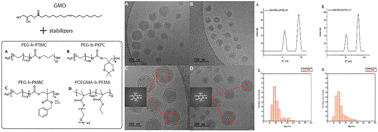
Amphiphilic copolymers represent a primary class of stabilizers for lipid–polymer hybrid nanoparticles. Among them, lyotropic liquid crystalline nanoparticles (LLCNPs) have some significant advantages, such as controlled release, targeted delivery and protection of active compounds, towards their use as potential carriers of active substances or drugs. The aim of this work is to study a series of linear amphiphilic block copolymers for stabilization of glyceryl monooleate [1-(cis-9-octadecenoyl)-rac-glycerol]-based lipid–polymer hybrid nanoparticles. For this purpose, poly(ethylene glycol)-b-poly(benzyl 5-methyl-2-oxo-1,3-dioxane-5-carboxylate), poly(ethylene glycol)-b-poly(9,9-dimethyl-2,4,8,10-tetraoxaspiro[5.5] undecan-3-one), and poly(ethylene glycol)-b-poly(trimethylene carbonate) were synthesized using anionic ring opening polymerization and poly[oligo(ethylene glycol) methacrylate]-b-poly(ethyl methacrylate) was synthesized by atom transfer radical polymerization. The chemical structures of copolymers were confirmed by 1H-NMR, while the molar masses were determined by SEC measurements. Lipid–polymer nanosystems were prepared by the top-down method. Their physicochemical and morphological characteristics were assessed through dynamic light scattering (DLS), cryogenic transmission electron microscopy (cryo-TEM), fast Fourier transform (FFT) analysis and microcalorimetry (mDSC). Varying the molar ratios of GMO to copolymers resulted in nanoparticles with different sizes and internal organization, with these properties being influenced by the type of hydrophobic block used in the copolymer, as can be expected and observed for other LLCNPs stabilized with amphiphilic block copolymers. This study introduces a broader group of amphiphilic polymeric stabilizers for the development of LLCNPs and highlights how variations in copolymer composition affect the structural characteristics and properties of emerging nanosystems.
 Please wait while we load your content...


