


 PLATFORM UPDATE:


Differential crosslinking and contractile motors drive nuclear chromatin compaction
 *a
Edward J.
Banigan
*b
and
*a
Edward J.
Banigan
*b
and
Abstract
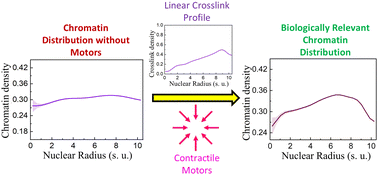
During interphase, the cell nucleus exhibits spatial compartmentalization between transcriptionally active euchromatin and transcriptionally repressed heterochromatin. In conventional nuclear organization, euchromatin is enriched in the nuclear interior, while heterochromatin – approximately 50% denser – resides near the periphery. The nuclear lamina, a deformable structural shell, further modulates peripheral chromatin organization. Here, we investigate a chromatin model in which an active, crosslinked polymer is tethered to a deformable lamina shell. We show that contractile motor activity, shell deformability, and the spatial distribution of crosslinks jointly determine compartmentalization. Specifically, a radial crosslink density gradient, even with a small increase toward the periphery, coupled with motor activity, drives genomic segregation consistent with experimental observations. This effect arises as motors preferentially draw crosslinks toward the periphery, forming dense domains that promote heterochromatin formation. Our model also predicts increased stiffness of nuclear wrinkles due to heterochromatin compaction beneath the lamina, consistent with instantaneous stiffening observed under nanoindentation. We conclude by outlining potential experimental approaches to validate our model predictions.
- This article is part of the themed collection: Soft Matter Open Access Spotlight 2026
 Please wait while we load your content...


