


 PLATFORM UPDATE:


Integrating density functional theory and machine learning for mechanical performance prediction of perovskite oxygen carriers in chemical looping combustion
 *a
*a
Abstract
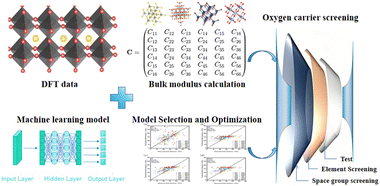
Chemical looping combustion (CLC) is an emerging combustion technology that has attracted increasing attention in the field of energy conversion due to its high efficiency, inherent CO2 separation capability, and low NOx emissions. In CLC systems, oxygen carriers play a critical role in heat and mass transfer, and their mechanical performance has a decisive impact on service lifetime and overall reaction performance. However, existing machine learning approaches for oxygen carrier design predominantly focus on reaction-related properties, while the lack of quantitative prediction methods for mechanical performance continues to result in high development costs. In this work, the bulk modulus is proposed as a key descriptor for evaluating the mechanical performance of oxygen carriers, and a combined first-principles calculation and machine learning framework is developed for mechanical property prediction. Over 4000 perovskite candidate materials were first generated based on valence-state and space-group combinations, and mechanically stable structures were screened using the Born stability criteria. Bulk moduli were then calculated and correlated with material hardness to establish a structure–mechanical property relationship. Subsequently, multiple machine learning models were trained to predict the bulk modulus of oxygen carriers, among which the random forest (RF) model achieved the best performance with R2 of 0.94. Finally, experimental validation via scanning electron microscopy and nanoindentation measurements confirmed that perovskite oxygen carriers such as LaCoO3, LaNiO3, and CaTiO3 exhibit bulk moduli exceeding 240 GPa, demonstrating excellent mechanical performance.
 Please wait while we load your content...


