


 PLATFORM UPDATE:


Enhancing the rate and efficiency of electrochemical ammonia synthesis from N2 in concentrated divalent electrolytes
 a
and
Alex
Schechter
*ab
a
and
Alex
Schechter
*ab
Abstract
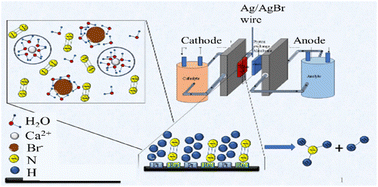
The electrochemical nitrogen reduction reaction (ENRR) is a promising alternative to the Haber–Bosch process, offering an energy-efficient and carbon-free method for ammonia synthesis. In the last few years, many catalyst materials have been investigated for N2 conversion to ammonia, where PtRu has shown relatively high activity, selectivity, and stability. This work describes a novel approach to increase the ENRR rate and efficiency by utilizing concentrated electrolytes (≥40 wt%) of common and nontoxic divalent CaBr2 and MgBr2, which have high hydration energy, resulting in low free water concentration. This results in high overpotential for the competing hydrogen evolution reaction and high N2 solubility while maintaining high conductivity (120–160 mS cm−1 at 30–60 wt%). These properties have been harnessed to improve the rate of ammonia formation and the faradaic efficiency (FE) of the kinetically sluggish ENRR. The highest NH3 production rate of 94.01 µg h−1 cm−2 and a FE of 23.7% at −0.15 V vs. the reversible hydrogen electrode (RHE) are observed in 60% CaBr2 solution using the PtRu alloy as the catalyst. This ammonia production rate is 2 times higher than that in 0.1 M KOH and 5 times higher than that in 0.25 M (4.75 wt%) CaBr2 electrolyte.
- This article is part of the themed collection: Sustainable Energy & Fuels Recent HOT Articles
 Please wait while we load your content...


