Advances in Interfacial Engineering of MXene-Based Photocatalysts for Solar CO₂ Conversion
Abstract
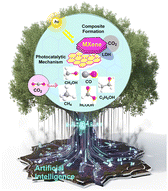
The escalating atmospheric CO₂ concentration poses a critical environmental challenge, necessitating innovative approaches for carbon capture and conversion. Photocatalytic CO₂ reduction represents a promising sustainable technology that harnesses solar energy to convert CO₂ into valuable chemical fuels and feedstocks, offering a dual benefit of greenhouse gas mitigation and renewable energy generation. Among emerging photocatalytic materials, twodimensional MXenes (M n+1 X n T x ) have attracted considerable attention due to their exceptional properties including metallic conductivity, tunable electronic structure, abundant surface terminations, large specific surface area, and remarkable light absorption across broad spectral ranges. This comprehensive review systematically examines the fundamental structure and properties of MXenes, critically evaluates various synthesis methodologies including HF etching, fluoride salt etching, fluoride-free approaches, chemical vapor deposition, hydrothermal methods, ultrasonic synthesis, and ball milling techniques, and elucidates the photocatalytic mechanisms governing CO₂ reduction on MXene-based surfaces. The review provides an in-depth analysis of recent advances in MXene-based composite photocatalysts, encompassing diverse heterostructure configurations including 2D/2D architectures, p-n heterojunctions, S-scheme and Z-scheme systems, and ternary composites integrated with metal oxides, carbon nitrides, layered double hydroxides, perovskites, and covalent organic frameworks. Special emphasis is placed on rational design strategies such as interfacial engineering, surface functionalization, hot electron injection mechanisms, and photothermal synergistic effects that enhance charge carrier separation, extend light absorption, and improve product selectivity toward C₁ (CO, CH₄, HCOOH, CH₃OH) and C₂ (C₂H₅OH) products. The emerging role of artificial intelligence and machine learning in accelerating MXene-based photocatalyst discovery through high-throughput computational screening, property prediction, synthesis optimization, and autonomous experimentation is comprehensively discussed. A balanced perspective is provided by critically examining both the positive attributes (superior charge separation, broad-spectrum light absorption, product tunability, noble metal-free design) and significant challenges (hazardous HF synthesis, oxidation instability, limited long-term stability data, economic viability concerns, scale-up complexities) that currently impede practical implementation. Future research directions are proposed, emphasizing the need for environmentally benign synthesis routes, comprehensive stability studies under realistic conditions, techno-economic analysis, advanced in-situ characterization for mechanistic understanding, scale-up strategies, and life cycle sustainability assessments. This review aims to provide researchers with a comprehensive understanding of the current state-of-the-art in MXene-based photocatalytic CO₂ reduction and inspire innovative approaches toward developing commercially viable technologies for sustainable carbon conversion and solar fuel production.
Please wait while we load your content...