


 PLATFORM UPDATE:


Methane synthesis from CO2 and H2O with concentrated NaOH–KOH electrolyte at 200–250 °C using electrochemical Pd–Ag membrane reactor
 *a
*a
Abstract
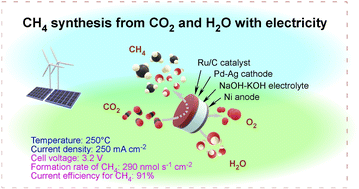
The synthesis of hydrocarbons from CO2 and H2O using electricity derived from renewable energy sources has attracted considerable attention. However, there is currently no direct electrochemical method capable of selectively producing specific hydrocarbons from CO2 reduction at low overpotentials. By employing an electrochemical membrane reactor that combines water electrolysis with thermocatalytic methanation, methane can be selectively produced at a cell voltage comparable to that of conventional water electrolysis. In this study, methane synthesis from CO2 and H2O was investigated using an electrochemical membrane reactor equipped with a 30 wt%-Ru/C catalyst, Pd-based alloy membrane, and a NaOH–KOH eutectic electrolyte operating at approximately 250 °C. At 250 mA cm−2 based on cathode geometric area and 250 °C, the methane and hydrogen production rate was 290 and 120 nmol s−1 cm−2, corresponding to a current efficiency of 91 and 9%, respectively. However, when the current density exceeded 250 mA cm−2, the total current efficiency suddenly deviated significantly from 100%, indicating a decrease in current efficiency due to product cross-leak. At 300 mA cm−2, significant evolution of H2 was detected in the anode-side exhaust gas. This cross-leak was also pronounced during operation below 200 °C. Impedance measurements determined that the specific resistance of the electrolyte at 250 °C was 0.50 S cm−1. The current efficiency and related characteristics of this methane synthesis method were discussed in detail.
- This article is part of the themed collection: Recent Open Access Articles
 Please wait while we load your content...


