


 PLATFORM UPDATE:


Ruthenium-anchored zirconium dioxide derived from a metal–organic framework as a highly efficient pH-universal electrocatalyst for hydrogen evolution

Abstract
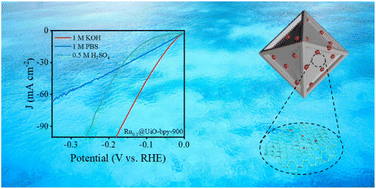
To enhance the efficiency of electrochemical water splitting for hydrogen production, it is essential to employ hydrogen evolution reaction (HER) electrocatalysts that lower the energy barrier and accelerate the HER kinetics. In this study, a ruthenium (Ru) nanoparticle-anchored zirconium dioxide (ZrO2) matrix derived from a Zr-based metal–organic framework (MOF), denoted as Rux@UiO-bpy-900 (bpy refers to bipyridine), was synthesized via a liquid-phase impregnation and subsequent calcination method at 900 °C. The incorporation of Ru, which exhibits platinum-like hydrogen binding energy, modulates the hybrid structure of UiO-bpy-derived carbon materials, enhances electron transport, and leverages the synergistic effect of Ru/Zr bimetallic sites to alter the electronic structure of the material, thereby improving the hydrogen evolution efficiency. The catalyst requires an overpotential of only 28 mV to achieve a current density of 10 mA cm−2 in 1 M KOH, outperforming the reference Pt/C catalyst. It also demonstrates superior HER activity across the entire pH range compared to UiO-bpy-900. This work provides a foundation for the development of MOF-based electrocatalysts suitable for energy conversion and storage applications.
 Please wait while we load your content...


