


 PLATFORM UPDATE:


Rational design strategies for carbon nanotube-based non-precious metal HER catalysts: a review
 *ab
*ab
Abstract
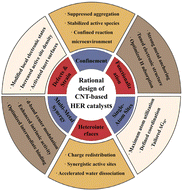
Developing efficient and cost-effective electrocatalysts for the hydrogen evolution reaction (HER) remains a central challenge for sustainable hydrogen production, as the replacement of platinum with non-precious metals is often limited by insufficient intrinsic activity and poor structural stability. In this context, carbon nanotubes (CNTs) have emerged as more than simple conductive additives and increasingly serve as active platforms for regulating electron transport, stabilizing catalytic species, and tailoring local reaction environments. This review adopts a materials design perspective rather than a conventional element based classification, and systematically examines how different design strategies exploit carbon nanotube frameworks to construct efficient non-precious metal HER catalysts. Representative approaches including single atom site engineering, heterointerface formation, multi metallic synergy, and defect or strain induced electronic modulation are discussed. Recent progress in CNT-based macroarchitectures aimed at improving mass transport and long-term electrode robustness is also summarized. By comparing these strategies across multiple length scales, this work extracts general structure activity and stability relationships, highlights recurring design principles that govern catalytic performance, and outlines future research directions toward more controllable synthesis, operando mechanistic understanding, and scalable electrode implementation.
- This article is part of the themed collection: Sustainable Energy & Fuels 2026 Review Articles
 Please wait while we load your content...


