


 PLATFORM UPDATE:


Engineering accessible Fe-N sites in polypyrrole-derived catalysts via a dynamic coordination strategy
 b
and
Qingmin
Ji
*a
b
and
Qingmin
Ji
*a
Abstract
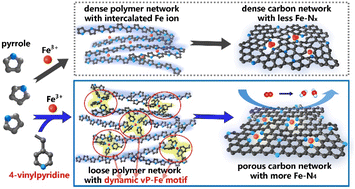
Polypyrrole (PPy) serves as an excellent N-rich precursor for Fe-N-C electrocatalysts, as its pyrrolic-N moieties not only facilitate metal coordination but also generate intrinsic carbon defects, promoting the formation of atomically dispersed active sites. However, excessive interchain cross-linking during polymerization often leads to dense, poorly porous carbon structures upon pyrolysis, severely limiting the accessibility of these active sites and overall catalytic performance. Herein, we report a “dynamic coordination motif” strategy by introducing 4-vinylpyridine (vP) as a co-monomer during the Fe-coordinated pyrrole polymerization. vP may compete with pyrrole for Fe coordination, forming dynamic Fe-vP complexes that act as molecular spacers within the growing polymer network. This process effectively inhibited dense chain packing, creates additional coordination anchors for Fe, and guides the formation of a more open architecture. After pyrolysis, this hybrid polymer transforms into a stable porous carbon matrix with rich pyridinic-N and a high density of accessible Fe-N sites. The resultant vP-Fe@PPy catalysts exhibited significantly superior ORR catalytic performance, outperforming both the vP-free, Fe-doped PPy-derived carbon and the commercial Pt/C catalyst. This work presents a facile and effective strategy for engineering highly accessible active sites in metal-doped carbon electrocatalysts, enabling tailorable metal loadings with uniform distribution.
- This article is part of the themed collection: Sustainable Energy & Fuels Recent HOT Articles
 Please wait while we load your content...


