


 PLATFORM UPDATE:


Engineering hemp-derived carbon–cobalt chalcogenide hybrids toward durable and high-capacity sodium-ion batteries
 a
Sedat
Yasar
*a
a
Sedat
Yasar
*a
Abstract
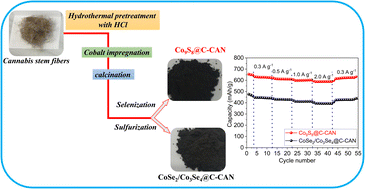
Biomass carbons (BCs) have emerged as a favored anode material for different types of batteries owing to their cost-effectiveness and environmental sustainability. However, their performance at elevated current densities is suboptimal, necessitating the development of BCs combined with other components that possess high theoretical capacities. Herein, we embedded Co9S8 and CoSe2/Co3Se4 nanoparticles onto porous carbon derived from stem fiber of the hemp (Cannabis sativa L.) plant template using an in situ growth method. This strategy reduces the dissolution of Co9S8 and CoSe2/Co3Se4 in the electrolyte, thereby preventing capacity loss, and heteroatom-containing carbon functionalities enhance interfacial interaction with cobalt chalcogenides and contribute to improved electrochemical stability. The synthesized Co9S8@C-CAN electrode, used as a sodium-ion battery (SIB) anode, demonstrates high reversible capacity and stable cycling behavior. Co9S8@C-CAN retains a capacity of 608 mA h g−1 after 250 cycles, even at a high current density of 2.0 A g−1, with a high cycle stability. This study presents a method for synthesizing hybrid materials by integrating BC with metal sulfides or metal selenides, introducing a novel strategy for the fabrication of SIB anodes.
- This article is part of the themed collection: Recent Open Access Articles
 Please wait while we load your content...


