


 PLATFORM UPDATE:


Synergistic plasmonic–semiconductor heterointerfaces enabling efficient CO2 hydrogenation to methanol under visible-light irradiation
 *g
and
Aminul
Islam
*abc
*g
and
Aminul
Islam
*abc
Abstract
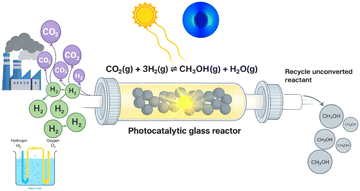
The photocatalytic conversion of carbon-dioxide (CO2) to methanol (CH3OH) under mild conditions has been regarded as a promising, cost-effective, and environmentally sustainable approach for carbon utilization and renewable fuel generation. However, the process has been hindered by limited charge separation efficiency and insufficient CO2 activation. In this study, a heterostructured Ag–Si/MgO/ZnO photocatalyst was rationally designed and synthesized via a solid-phase reaction method. A CH3OH production rate of 357.53 µmol gcat−1 h−1 was achieved over the optimized 10% Ag–Si/MgO/ZnO composite catalyst at 250 °C, representing a substantial enhancement compared to the Si/ZnO and Si/MgO/ZnO photocatalysts. The CH3OH production performance was found to be higher in the photocatalyst/gas-phase system than that reported in comparable studies. The theoretical activation energy for Ag–Si/MgO/ZnO was found to be 158.14 kJ mol−1, which is lower than that of Si/MgO/ZnO (167.79 kJ mol−1) and Si/ZnO (177.97 kJ mol−1), indicating enhanced CO2 activation and higher CO2 conversion. More importantly, after more than 72 h of irradiation, the system still exhibited a high CH3OH production rate, demonstrating its potential for practical application.
- This article is part of the themed collection: Recent Open Access Articles
 Please wait while we load your content...


