


 PLATFORM UPDATE:


The dual role of borohydride salts in enhancing perovskite solar cell performance and stability
 ad
Carina
Pareja-Rivera,
a
Hector Juarez
S.,
d
Sofia
Masi,
*a
Eva M.
Barea,
*a
Silver-Hamill
Turren-Cruz
*b
and
Iván
Mora-Seró
*a
ad
Carina
Pareja-Rivera,
a
Hector Juarez
S.,
d
Sofia
Masi,
*a
Eva M.
Barea,
*a
Silver-Hamill
Turren-Cruz
*b
and
Iván
Mora-Seró
*a
Abstract
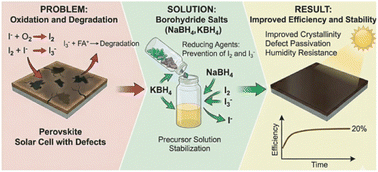
A key problem for materials that form lead-based perovskite is the part of organic iodide that is oxidized and forms molecular I2, which negatively affects the efficiency and stability of the solar cell. Herein, we explored adding special compounds, two borohydride salts, potassium borohydride (KBH4) and sodium borohydride (NaBH4), into the perovskite precursor solution. These borohydride salts help prevent the oxidation process by acting as reducing agents, preventing the defects caused by I2 by converting it back to I−. Also, I3− is generated from I2 and I−, which has a strong binding affinity to FA+, leading to deprotonation and decomposition of the perovskite. Borohydride salts can prevent this degradation and help stabilize the precursor solution. Furthermore, borohydride salts have a second role, enhancing film crystallinity and defect passivation and increasing humidity resistance, which improves overall stability and device performance. As a result, a promising efficiency of 20% is achieved, exhibiting long-term stability.
- This article is part of the themed collection: Recent Open Access Articles
 Please wait while we load your content...


