


 PLATFORM UPDATE:


Elucidating the O2 reduction reaction on 2D monolayer LaMnO3 perovskite
 *ab
*ab
Abstract
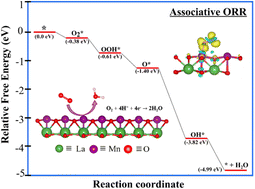
The O2 reduction reaction (ORR) is critical in energy conversion technologies such as proton exchange membrane fuel cells (PEMFCs) and metal-air batteries (MABs), and it is a fundamental reaction related to various disciplines such as energy conversion, material dissolution and renewable green energy technology. Despite extensive research, efficient and cost-effective catalysts remain a great challenge for scientists. Platinum-based catalysts, while effective, are prohibitively expensive and lack durability. In this work, a novel 2D monolayer LaMnO3 perovskite was computationally modeled by cleaving a (001) plane from the 3D LaMnO3 cubic perovskite. The 2D monolayer showed a high density of states along with overlapping energy bands at the Fermi level, indicating its potential for use as a cathode material. Detailed ORR pathways, including dissociative and associative reaction mechanisms, were explored on the surfaces of 2D monolayer LaMnO3. For all the intermediates involved in the ORR, the changes in Gibbs free energy (ΔG) were calculated by employing the PBE-D method. The 2D monolayer LaMnO3 demonstrated superior selectivity for the associative mechanism than for the dissociative mechanism, as described by the obtained free energy diagram or potential energy surface (PES) plot. Bader charge analysis confirmed a charge transfer of +0.6 |e| during the adsorption of O2 on the surface of the 2D monolayer LaMnO3 perovskite. The calculated value of the theoretical overpotential was found to be 1.01 V for 2D monolayer LaMnO3. This theoretical/computational groundwork lays the foundation for future applications of 2D monolayer LaMnO3 perovskite-based electrocatalysts, indicating their promise as Pt-free alternatives for fuel cell components.
 Please wait while we load your content...


