


 PLATFORM UPDATE:


MgO/CuO modified stainless steel mesh cathode for enhanced CO2 reduction to biomethane in a microbial electrosynthesis system

Abstract
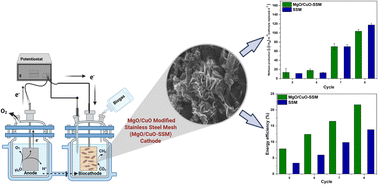
The microbial electrosynthesis system (MES) offers an attractive platform for effective cathodic reduction of carbon dioxide (CO2) to biomethane (CH4). However, achieving high productivity and energy efficiency remains challenging, often due to sluggish hydrogen evolution reaction (HER) kinetics at the cathode. Here, we showed an efficient CO2 reduction reaction with a stainless steel mesh cathode electrodeposited with magnesium oxide (MgO) and copper oxide (CuO); MgO/CuO-SSM. The electrodes are coupled with an enriched anaerobic culture to facilitate the bioproduction of CH4 from CO2. Material characterization confirmed the successful deposition of MgO and CuO on SSM, while electrochemical analysis revealed superior catalytic performance of the composite electrode compared to bare SSM. Furthermore, optimizing the applied cathode potential from −1 V to −0.9 V vs. Ag/AgCl/KCl (sat'd) for modified SSM improved the methane production while increasing the electrical energy efficiency. At −0.9 V vs. Ag/AgCl/KCl (sat'd), MgO/CuO-SSM recorded an energy efficiency of 21.6% (103.8 ± 3.8 L(CH4) m−3(catholyte replaced) d−1), surpassing that of bare SSM (14.7%, 117.5 ± 3.6 L(CH4) m−3(catholyte replaced) d−1) operated at −1 V vs. Ag/AgCl/KCl (sat'd). Overall, our work introduces a promising and facile electrode modification strategy that enhances MES performance, enabling CO2 reduction to CH4 at reduced energy demand towards practical carbon neutrality applications.
- This article is part of the themed collection: Recent Open Access Articles
 Please wait while we load your content...


