


 PLATFORM UPDATE:


Computational study of OH, NH2-functionalized iron-doped tetraphenylporphyrin as a photocatalyst for CO2 reduction to C1 fuels
 b
and
Angappan
Mano Priya
*c
b
and
Angappan
Mano Priya
*c
Abstract
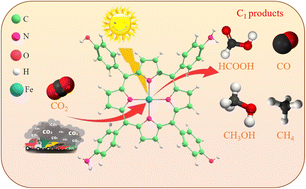
The photocatalytic CO2 reduction reaction (CO2RR) has attracted considerable attention as a promising strategy for sustainable fuel production. Recent efforts have focused on enhancing the catalytic performance of iron-doped tetraphenylporphyrin (Fe-TPP) through chemical modification. This work has systematically investigated the hydroxyl, amino-functionalized Fe-TPP (Fe-OHTPP and Fe-NH2TPP) as a photocatalyst for CO2RR using density functional theory (DFT) calculations. The HOMO–LUMO analysis reveals that the Fe center acts as an electronic bridge, promoting efficient charge transfer. To explore the photocatalytic mechanism, we examined the most favorable adsorption configurations of key intermediates and evaluated their reaction and Gibbs free energies. The calculated limiting potential of Fe-NH2TPP is −0.24 eV, and the adsorption energy of the C1 product CH4 molecule is −0.05 eV for both surfaces, indicating that the catalyst remains stable and reusable after product release. Overall, the results demonstrate that Fe-OHTPP and Fe-NH2TPP catalysts thermodynamically favors C1 production, providing mechanistic insights of CO2 conversion into value-added chemical fuels via hydroxyl, amino-functionalized Fe-TPP photocatalysts.
 Please wait while we load your content...


