


 PLATFORM UPDATE:


First principles study of two-dimensional Li3CX (X = S and Se) monolayers for hydrogen storage
 *a
*a
Abstract
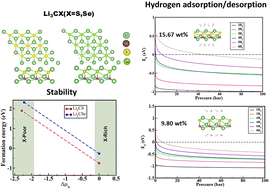
The persistent challenges in designing lightweight, reversible hydrogen storage materials are addressed by utilizing a density functional approach and ab initio molecular dynamics (AIMD) analysis of newly proposed Li3CX (X = S and Se) monolayers. The pristine monolayers exhibit robust thermodynamic stability, and upon the sequential adsorption of a maximum of six hydrogen (H2) molecules, they achieve significant gravimetric storage capacities of 15.67 wt% for Li3CS and 9.80 wt% for Li3CSe. The average adsorption energy (0.22 eV) of the H2 molecule lies within the ideal range of cyclable physisorption, facilitating reliable hydrogen uptake and release under room temperature. Desorption temperatures decrease predictably with surface coverage, reaching 281 K for 6H2@Li3CS and 346 K for 6H2@Li3CSe, indicative of low-energy release potential. These results underscore the practical viability of the Li3CX monolayers as a high-capacity, thermally stable, and structurally resilient hydrogen storage medium for next-generation clean energy technologies. Our investigations provide valuable insights for experimentalists exploring two-dimensional monolayers with practical hydrogen storage capabilities.
 Please wait while we load your content...


