


 PLATFORM UPDATE:


Structurally self-anchoring bipolar membranes with interlocked interfaces for coupled hydrogen production and biomass electrosynthesis

Abstract
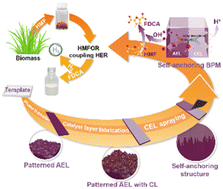
The development of efficient and multifunctional electrochemical systems is critical for advancing sustainable hydrogen production and green chemical synthesis. Herein, we report a structurally self-anchoring bipolar membrane (SA-BPM) fabricated via a scalable templated casting strategy that enables spontaneous physical interlocking between the cation exchange layer (CEL) and the anion exchange layer (AEL). This architecture significantly enhances interfacial adhesion, mechanical stability, and water dissociation kinetics. When integrated into an electrolyzer, the SA-BPMWE demonstrates a remarkably high current density of 900 mA cm−2 at 2.92 V, which is more than twice the current density of the S-BMPWE without a self-anchored morphology (S-BPMWE, 374 mA cm−2) under the same conditions. Moreover, coupling cathodic hydrogen evolution with anodic 5-hydroxymethylfurfural (HMF) oxidation via the SA-BPM yields a current density of 10 mA cm−2 at only 0.72 V, enabling simultaneous H2 generation and production of 2,5-furandicarboxylic acid (FDCA) with 83.96% HMF conversion and 41.34% yield. This work highlights the critical role of interfacial structure in bipolar membranes and establishes a versatile membrane–electrode platform for integrated energy and chemical manufacturing applications.
- This article is part of the themed collection: Sustainable Energy & Fuels Recent HOT Articles
 Please wait while we load your content...


