


 PLATFORM UPDATE:


A critical review on the design strategies of SFM-based perovskite oxides for high-temperature CO2 electrolysis in solid oxide electrolysis cells

Abstract
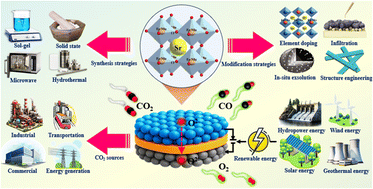
Solid Oxide Electrolysis Cells (SOECs) enable high-temperature CO2 electrolysis, offering enhanced efficiency, faster reaction kinetics, and the potential for direct syngas production—advantages that low-temperature methods often lack due to higher overpotentials and sluggish reaction rates. Among the candidate materials, Sr2Fe1.5Mo0.5O6−δ (SFM) has gained considerable interest due to its mixed ionic–electronic conductivity, excellent redox stability, and favorable catalytic properties toward CO2 reduction. However, despite its potential, the practical utilization of SFM is hindered by limitations such as insufficient intrinsic catalytic activity, surface segregation, limited active site density, and performance degradation during long-term operation. In this review, we systematically discuss the origin, structure, and elemental properties of SFM, followed by a comprehensive overview of recent synthesis strategies, including the solid-state reaction method and sol–gel method. Subsequently, various modulation strategies, such as elemental doping, compositing, nano-catalyst infiltration, in situ exsolution, and nanostructure engineering are discussed to demonstrate pathways for enhancing catalytic activity, stability, and overall performance. To address degradation concerns, we outline several mitigation strategies reported in the literature. Furthermore, an economic analysis is also incorporated to assess the techno-economic viability and practical scalability of this technology. Finally, future perspectives are presented to highlight the important future considerations and provide a roadmap for this rapidly growing technology. By integrating these key aspects, this review shows a significant understanding of SFM double perovskite in CO2 electrolysis in SOECs and highlights potential directions for future investigations and technological advancements.
- This article is part of the themed collection: Sustainable Energy & Fuels 2026 Review Articles
 Please wait while we load your content...


