


 PLATFORM UPDATE:


Sustainable future strategies towards the reuse and recycling of lithium-ion batteries: a concise account of materials and methods

Abstract
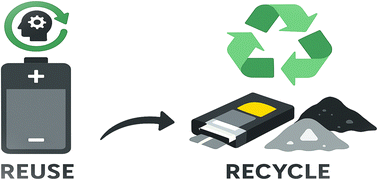
The unprecedented accumulation of battery waste originating from diverse lithium-ion battery (LIB) sources such as electric vehicles (EVs), portable gadgets, and renewable energy storage systems has created serious problems in terms of resource sustainability, the economy, and the environment. This study critically evaluates the existing state of LIB recycling and reuse of end-of-life EV-batteries, with a special focus on pyrometallurgical, hydrometallurgical, and direct recycling techniques. Hydrometallurgy offers greater recovery rates but has difficulties managing chemical waste. Pyrometallurgy, despite being commercially established, suffers from excessive energy consumption and loss of vital materials such as lithium. Although scalability is still an issue, direct recycling is an inventive method that maintains the integrity of the cathode structure and provides a financially viable and ecologically friendly substitute. Furthermore, second-life applications of EV batteries prior to recycling provide a promising path for grid storage and renewable energy integration. This review addresses important issues in battery disassembly, safety, and material purity while highlighting current developments in sustainable binder materials, innovative electrolyte compositions, and selective lithium recovery. In order to promote a circular battery economy, the economic and environmental effects of LIB waste are examined closely, highlighting the pressing need for closed-loop recycling infrastructure and legislative frameworks. This work offers a road map for sustainable LIB management by integrating state-of-the-art recycling technology with second-life uses, striking a balance between resource recovery, environmental preservation, and financial feasibility as we move towards a green energy future.
 Please wait while we load your content...


