


 PLATFORM UPDATE:


Thermal diffusion of hydrogen-containing gas mixtures: applications to underground hydrogen storage

Abstract
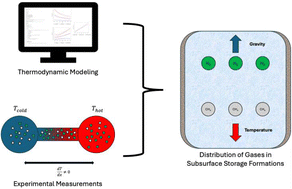
The modeling of underground hydrogen (H2) storage (UHS) requires understanding the thermodynamics of H2-containing gas mixtures as they approach local equilibrium during storage while subjected to temperature gradients and gravity segregation. Previous investigations using a model based on irreversible thermodynamics have shown the need for experimental measurements of hydrogen thermal diffusion in natural gas to better understand hydrogen composition versus depth during UHS. This work presents thermal diffusion measurements for H2 in methane (CH4) at varying temperatures and compositions. The effect on thermodynamic modeling is discussed, and the effect of other cushion gases such as carbon dioxide (CO2) is also explored. For the H2–CH4 system, it was found that the thermal diffusion factor (αT) increases as a function of composition and temperature, with values ranging from αT = 0.22–0.36 for H2 mole fractions ranging from xH2 = 0.3−0.7. At a fixed composition of 50% H2 and 50% CH4, αT ranged from 0.21 to 0.29 for a median temperature ranging from 250 K to 450 K. Using these values, a reference ideal gas enthalpy of 3.5 kJ mol−1 for CH4 while setting the reference ideal gas enthalpy of H2 to 0 kJ mol−1 is needed to properly match the model with the experimental observations at a constant median temperature. For experiments at varying median temperature, a correlation is needed between the enthalpy of the reference ideal gas of CH4 and the departure of the median temperature from the reference state temperature to match adequately the model with the experimental values. The effect of adding these thermal considerations leads to a more homogeneous mix of H2 with its cushion gas than previously anticipated. Further study of UHS operations could include the effects of shut-in time to determine gas purity during production cycles.
- This article is part of the themed collection: Sustainable Energy & Fuels 2026 Review Articles
 Please wait while we load your content...


