


 PLATFORM UPDATE:


Synergistic stabilization of lead halide perovskites by univalent cations under electric field stress
 *a
Victoria V.
Ozerova,
a
Mikhail V.
Zhidkov,
a
Lavrenty G.
Gutsev,
ac
Lyubov A.
Frolova
a
and
Pavel A.
Troshin
ea
*a
Victoria V.
Ozerova,
a
Mikhail V.
Zhidkov,
a
Lavrenty G.
Gutsev,
ac
Lyubov A.
Frolova
a
and
Pavel A.
Troshin
ea
Abstract
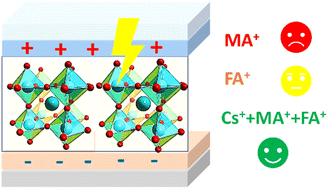
The low operational stability of perovskite solar cells, primarily caused by ion migration under photogenerated electric fields, remains one of the key barriers to their practical deployment. In the present paper, we report the results of a comparative study of the field-induced aging dynamics in lead iodide perovskite films with different univalent cation compositions: MAPbI3, FAPbI3, Cs0.15FA0.85PbI3 and Cs0.1MA0.15FA0.75PbI3. By employing a complementary suite of techniques including IR s-SNOM, PL microscopy, SEM/EDX, and ToF-SIMS mapping, alongside AIMD simulations of hydrogen on the surface of FAPbI3, we visualized the dynamic behavior of cations and anions during aging and identified the corresponding reaction products. The simulations revealed that surface-based hydrogen can destabilize the lattice by abstracting surface iodine, in agreement with experimentally observed degradation of FAPbI3, where volatile species are produced. It is shown that the formamidinium cations have a significantly higher resistance to electric fields when compared to the methylammonium cations. Univalent cation induced phase segregation has been observed for multication perovskite films upon electric field exposure. The results obtained provide a deep insight into the mechanistic pathways of the electrodegradation of differently composed lead halide perovskites and pave the way for the rational design of a new generation of perovskite absorber materials that can resist electric field-induced damage.
- This article is part of the themed collection: Sustainable Energy & Fuels 2025 HOT Articles
 Please wait while we load your content...


