Cobalt molybdenum oxide nanorod decorated carbon yarn for non-enzymatic electrochemical detection of epinephrine

Abstract

Epinephrine (EP), a critical hormone secreted by the adrenal glands, is a vital clinical biomarker linked to various neurological and cardiovascular disorders, making its accurate monitoring essential for diagnosis and patient management. Herein, we report a nonenzymatic electrochemical sensor for EP detection based on carbon yarn (CY) functionalized with cobalt molybdenum oxide (CMO) nanorods. A liquid/liquid interface-assisted strategy using n-butanol and water was employed to tailor the growth of CMO nanostructures. Importantly, the influence of metal precursor concentration on morphology evolution and electrochemical performance was systematically investigated. Controlled nanorod architectures of CMO were formed at optimized concentrations, whereas higher concentrations yielded irregular flake-like structures with minor impurity phases and reduced activity. The optimized CMO-modified carbon yarn exhibited excellent electrochemical activity for EP detection, demonstrating high selectivity, stability, repeatability, and a low detection limit of 2.14 nM. The sensor's practical applicability was validated using real samples, including EP injection solutions and human serum. Finally, a flexible device was fabricated, delivering promising performance.
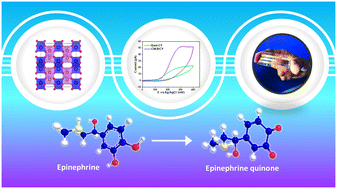
Graphical abstract: Cobalt molybdenum oxide nanorod decorated carbon yarn for non-enzymatic electrochemical detection of epinephrine

Supplementary files

Article information

Article type
Paper
Submitted
16 Feb 2026
Accepted
30 Apr 2026
First published
17 Jun 2026
This article is Open Access
Creative Commons BY-NC license

Sens. Diagn., 2026, Advance Article

Cobalt molybdenum oxide nanorod decorated carbon yarn for non-enzymatic electrochemical detection of epinephrine

P. Mecheri, S. V. Iyer, L. B. Raveendran and M. M. Menamparambath, Sens. Diagn., 2026, Advance Article , DOI: 10.1039/D6SD00040A

This article is licensed under a Creative Commons Attribution-NonCommercial 3.0 Unported Licence. You can use material from this article in other publications, without requesting further permission from the RSC, provided that the correct acknowledgement is given and it is not used for commercial purposes.

To request permission to reproduce material from this article in a commercial publication, please go to the Copyright Clearance Center request page.

If you are an author contributing to an RSC publication, you do not need to request permission provided correct acknowledgement is given.

If you are the author of this article, you do not need to request permission to reproduce figures and diagrams provided correct acknowledgement is given. If you want to reproduce the whole article in a third-party commercial publication (excluding your thesis/dissertation for which permission is not required) please go to the Copyright Clearance Center request page.

Read more about how to correctly acknowledge RSC content.

Social activity

Spotlight

Advertisements