


 PLATFORM UPDATE:


Transition metal dichalcogenides as platforms for biosensing, phototherapy, and drug delivery
 *ab
*ab
Abstract
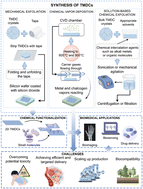
Two-dimensional transition metal dichalcogenides (TMDCs) are advancing from model nanomaterials to clinically relevant biointerfaces. Their atomic thickness, tunable band structures, strong light–matter coupling, and chemically addressable surfaces enable this progress. This review connects structure–property–function relationships to synthesis routes, including mechanical exfoliation, chemical vapor deposition, and solution-phase exfoliation. These methods control layer number, phase, defect chemistry, and lateral size. We outline how covalent or non-covalent functionalization, heterostructuring, and doping expand colloidal stability, targeting specificity, and robustness in physiological media. TMDCs leverage their high surface area and semiconducting properties to enable ultrasensitive biosensing across field-effect, electrochemical, and fluorescence/colorimetric approaches. They also enable stimuli-responsive drug delivery with spatiotemporal control and multimodal bioimaging. Modalities span photoluminescence, photoacoustic, two-photon, and MRI-hybrid platforms. Broadband near-infrared absorption supports efficient photothermal and photodynamic cancer therapies, enabling synergistic theranostics. Mechanically compliant, conductive composites position TMDCs for tissue engineering and regenerative scaffolds. We critically assess biocompatibility and long-term fate, focusing on phase or defect chemistry, protein coronas, reactive oxygen species, and degradation pathways. Translational bottlenecks include batch variability, scalable manufacturing with phase control, deep-tissue activation, standardized characterization, and regulatory readiness. We map these to a practical roadmap integrating reproducible synthesis, harmonized materials descriptors, in vivo pharmacokinetics or toxicology standards, and interoperable device integration. Together, TMDCs are emerging as a coherent materials platform for precision diagnostics, targeted therapy, and regeneration, with milestones toward clinical adoption.
 Please wait while we load your content...


