


 PLATFORM UPDATE:


Unlocking the potential of proton-mediated detection of ascorbic acid with a Ni–Co bimetallic MOF based extended gate FET

Abstract
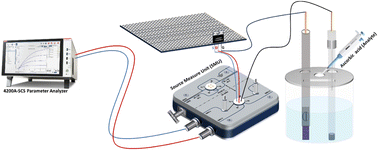
The possibility to quantify ascorbic acid (AA) using a Ni–Co MOF-coated carbon paper electrode within an extended gate FET setup (EGFET), operated at zero gate potential (open-circuit potential, OCP), has been investigated. Under these conditions, the Ni–Co MOF/CP electrode outperformed the single metal-based Ni-MOF and Co-MOF, demonstrating a wide detection range from 454 nM to 224.9 μM, encompassing both low and high AA levels in human blood, and a response time under 7 seconds. The sensor has shown a pronounced selective response to AA in the presence of several potential interferents such as glucose, sucrose, nicotine, lactose, and fructose. The sensitivity of the Ni–Co MOF/CP sensor to AA was estimated as 6.5284 nA μM−1 cm−2, with a limit of detection (LOD) of 45.1 nM and a limit of quantification (LOQ) of 136 nM. These findings indicate the potential and suitability of the Ni–Co MOF/CP electrode for detecting ascorbic acid in human blood serum. A key novelty of this work is the use of OCP to detect AA with Ni–Co MOF/CP, leveraging proton conduction via a combined Grotthuss and vehicular mechanism.
 Please wait while we load your content...


