


 PLATFORM UPDATE:


Enhancing wearable piezoelectric sensors via micro-textured P(VDF–TrFE)/BaTiO3 nanofiber mats for physiological monitoring
 *bde
*bde
Abstract
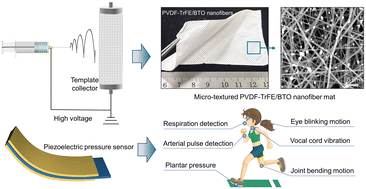
The advancement of wearable electronics for personalized healthcare demands flexible, high-performance pressure sensors capable of detecting both subtle physiological signals and large mechanical motions. In this work, we present a highly sensitive piezoelectric pressure sensor based on a micro-textured PVDF–TrFE/BaTiO3 composite nanofiber mat, fabricated via a facile electrospinning process. A commercial paper napkin was employed as a template collector to directly imprint a micro-structured architecture onto the nanofiber mat, eliminating the need for complex processes. The addition of BaTiO3 (BTO) nanoparticles significantly enhanced the piezoelectric response. The optimized piezoelectric sensor demonstrated outstanding performance with a sensitivity of ∼197 mV kPa−1, a fast response time of 3.5 ms, excellent frequency stability, and durability over 5000 loading cycles. Practical applicability was successfully verified through real-time monitoring of diverse physiological activities including arterial pulse, respiration, vocal vibrations, eye blinking, joint motion, and plantar pressure detection. These results underscore the potential of our sensor for use in wearable health monitoring, sports biomechanics, and human–machine interfaces, offering a scalable and cost-effective route to high-performance pressure sensing.
- This article is part of the themed collection: 2026 Chinese New Year and Lunar New Year Collection: Analytical Science
 Please wait while we load your content...


