Reproducible single-molecule optofluidic-SERS analysis on nanostar-activated diatom biosilica capsules

Abstract

Single-molecule (SM) analysis with surface-enhanced Raman scattering (SERS) usually requires sophisticated engineering on plasmonic nanostructures to provide extremely strong hot-spots to enhance the intrinsically weak signal. In this work, we report a cell-sized biosilica capsule based on the diatom Pinnularia sp. frustule decorated with high-density bimetallic nanostars consisting of gold and silver, capable of achieving reproducible single-molecule SERS analysis. Such a plasmonic nanostar-activated biological photonic crystal nanostructure synthesized by a simple self-assembly method enhances hot-spots universally, which is proved by finite difference time domain simulation. The cell-sized biosilica capsule also concentrates trace-levels of target molecules from ultra-small fluidic droplets through a drop-on-demand inkjet-printing technique. We experimentally demonstrated reproducible SM optofluidic-SERS sensing from 120 nL of 10−15 M rhodamine 6G solution containing only 72 molecules through statistical analysis of mapping data over the cell-sized biosilica capsule, achieving a 3× higher signal-to-noise ratio and 9× better SM detection possibility compared to that on the glass substrate.
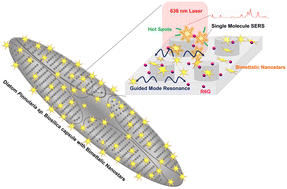
Graphical abstract: Reproducible single-molecule optofluidic-SERS analysis on nanostar-activated diatom biosilica capsules

Supplementary files

Transparent peer review

To support increased transparency, we offer authors the option to publish the peer review history alongside their article.

View this article’s peer review history

Article information

Article type
Paper
Submitted
03 Sep 2025
Accepted
25 Nov 2025
First published
29 Nov 2025
This article is Open Access
Creative Commons BY-NC license

Sens. Diagn., 2026, Advance Article

Reproducible single-molecule optofluidic-SERS analysis on nanostar-activated diatom biosilica capsules

S. Juneja, S. Biswas, K. Rong and A. X. Wang, Sens. Diagn., 2026, Advance Article , DOI: 10.1039/D5SD00161G

This article is licensed under a Creative Commons Attribution-NonCommercial 3.0 Unported Licence. You can use material from this article in other publications, without requesting further permission from the RSC, provided that the correct acknowledgement is given and it is not used for commercial purposes.

To request permission to reproduce material from this article in a commercial publication, please go to the Copyright Clearance Center request page.

If you are an author contributing to an RSC publication, you do not need to request permission provided correct acknowledgement is given.

If you are the author of this article, you do not need to request permission to reproduce figures and diagrams provided correct acknowledgement is given. If you want to reproduce the whole article in a third-party commercial publication (excluding your thesis/dissertation for which permission is not required) please go to the Copyright Clearance Center request page.

Read more about how to correctly acknowledge RSC content.

Social activity

Spotlight

Advertisements