


 PLATFORM UPDATE:


Artificial intelligence-powered signal analysis of loop-mediated isothermal amplification (LAMP) for the screening of Kaposi sarcoma at the point of care
 a
Juan
Boza,
a
Jason
Manning,
a
Xinying
Chu,
b
Ethel
Cesarman,
c
Aggrey
Semeere,
d
Jeffrey
Martin
e
and
David
Erickson
*bf
a
Juan
Boza,
a
Jason
Manning,
a
Xinying
Chu,
b
Ethel
Cesarman,
c
Aggrey
Semeere,
d
Jeffrey
Martin
e
and
David
Erickson
*bf
Abstract
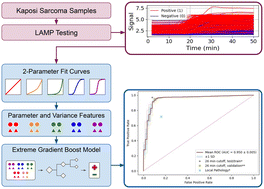
Unlike the polymerase chain reaction (PCR), loop-mediated isothermal amplification (LAMP) lacks a consistent thermal cycle, making quantification particularly challenging. Previously, we demonstrated that LAMP can accurately diagnose Kaposi sarcoma (KS) from skin lesion biopsies at the point of care (receiver operating characteristic area under the curve (AUC) = 0.967). A common approach in LAMP analysis involves setting a minimum absorbance threshold and time cutoff for positivity, which can introduce bias. We present a less biased, automated signal processing approach involving the fitting of a signal curve to five, two-parameter algebraic function fits, and the training of an artificial intelligence (AI) model on those parameters and their variances. An extreme gradient boosting (XGB) model was trained and tested on a primary dataset consisting of 1317 LAMP curves (from 451 unique patient samples with replicates). Five-fold k-validation on the train/test set yielded an receiver operating curve (ROC) area under the curve (AUC) of 0.952 ± 0.029. Each of the five-fold models were then validated on a separate secondary dataset of 966 LAMP curves (from 414 unique patient samples with replicates) and achieved an AUC of 0.950 ± 0.005. While the traditional methodology (which did not implement k-validation or a test/train split) outperformed the AI model's train/test set performance, the AI model generalized better and achieved a higher accuracy on the validation set (0.950 ± 0.005 vs. 0.9347). It performed even better when the analysis was applied directly to the raw signal data without additional pre-processing steps such as artifact filtering. This suggests that the AI model is more generalizable to new data and is able to discriminate KS-present and KS-absent samples better than traditional methods.
 Please wait while we load your content...


