


 PLATFORM UPDATE:

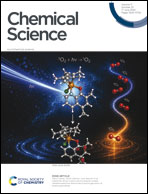
Self-assembled chemiluminescent nanoprobes based on α,α-dicyanoolefins: leveraging a dioxetane “funnel” for high-contrast inflammation imaging
 *c
and
*c
and
Abstract
Although peroxynitrite (ONOO−) chemiluminescence (CL) imaging offers near-zero background sensitivity for in vivo sensing, developing CL probes remains a formidable challenge due to the limited repertoire of chemiluminescent scaffolds and boronate-related cross-reactivity. Herein, we report the rational design of self-assembled chemiluminescent nanoprobes utilizing an α,α-dicyanoolefin scaffold. The optimal candidate, YMTPT-NPs, spontaneously forms stable nanoparticles in water and achieves orthogonal ONOO− specificity via its C![[double bond, length as m-dash]](https://www.rsc.org/images/entities/char_e001.gif) C bond of α,α-dicyanoolefin, eliminating H2O2 interference. Experimental and density functional theory (DFT) calculations elucidate that ONOO− attack forms a dioxetane intermediate, triggering sequential O–O cleavage to access an S1–S0 near-degenerate “funnel” and subsequent excited-state C–C cleavage. This mechanism efficiently channels chemical energy to drive robust intermolecular CRET within the confined nano-architecture. In a murine acute arthritis model, YMTPT-NPs exhibited an extended functional imaging window (>15 min) and a superior signal-to-background ratio (SBR = 31.38). This study establishes a robust supramolecular paradigm for constructing CL probes that combine practical signal duration, superior specificity, and red-shifted emission for precision in vivo imaging of inflammation.
C bond of α,α-dicyanoolefin, eliminating H2O2 interference. Experimental and density functional theory (DFT) calculations elucidate that ONOO− attack forms a dioxetane intermediate, triggering sequential O–O cleavage to access an S1–S0 near-degenerate “funnel” and subsequent excited-state C–C cleavage. This mechanism efficiently channels chemical energy to drive robust intermolecular CRET within the confined nano-architecture. In a murine acute arthritis model, YMTPT-NPs exhibited an extended functional imaging window (>15 min) and a superior signal-to-background ratio (SBR = 31.38). This study establishes a robust supramolecular paradigm for constructing CL probes that combine practical signal duration, superior specificity, and red-shifted emission for precision in vivo imaging of inflammation.

 Please wait while we load your content...


