


 PLATFORM UPDATE:


Tetraphenylborate-based anionic metal–organic framework as an efficient single-ion conductor for solid-state sodium batteries

Abstract
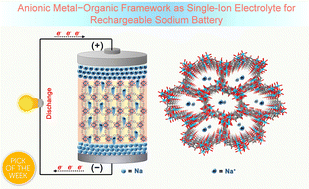
Rechargeable sodium batteries (RSBs) have emerged as promising candidates in the post-lithium electrification era. However, their applications are often complicated by their inherent reactivity with flammable liquid electrolytes, which leads to dendrite growth, parasitic side reactions, and rapid performance degradation. In particular, conventional dual-ion electrolytes can exacerbate uncontrolled mossy and dendritic sodium metal growth, severely compromising their performance. In this work, we propose a tetraphenylborate-supported anionic metal–organic framework (MOF) as a promising single-ion conductive electrolyte to address the limitations of liquid dual-ion electrolytes. The anionic MOF is synthesized by reacting the sodium tetraphenylborate [Na+B(PhCOOH)4−] building block with a Zr6-oxo cluster. Na+ counterions are directly encapsulated and serve as the free mobile charge carrier, achieving an ionic conductivity of 0.407 mS cm−1, an activation energy of 0.19 eV, and a Na+ transference number of 0.90. The developed anionic MOF-based solid-state electrolyte exhibits good interfacial compatibility with sodium metal and excellent rate performance. A combination of these properties enables the assembled solid-state RSB to deliver a remarkable capacity of 529 mA h g−1 at 0.1 A g−1 under ambient conditions and retain 424 mA h g−1 at 2 A g−1, with a capacity retention of 93.8% after 2500 charge–discharge cycles. Moreover, the fabricated solid-state RSB can operate stably within a temperature range of −40 to 70 °C and at current densities from 0.1 to 10 A g−1. Furthermore, Na+ ions in the anionic MOF can be exchanged with K+ and Zn2+, establishing this anionic MOF as a versatile single-ion solid electrolyte for solid-state potassium and zinc batteries, which deliver the capacities of 437 and 554 mA h g−1, respectively. This work not only establishes anionic MOFs as versatile and promising solid-state electrolytes for various types of solid-state batteries but also outlines a design blueprint for other anionic porous materials in energy storage.
- This article is part of the themed collections: 2026 Chemical Science HOT Article Collection and 2026 ChemSci Pick of the Week Collection
 Please wait while we load your content...


