


 PLATFORM UPDATE:


Mechanistic insights into interfacial failure of hard carbon anodes in sodium-ion batteries under extreme conditions
 *ab
*ab
Abstract
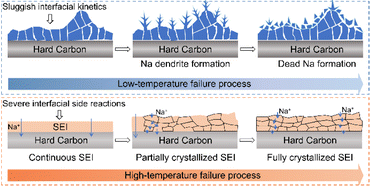
Revealing the failure mechanisms of hard carbon (HC) anodes under extreme temperatures is crucial for the wide-temperature applications of sodium-ion batteries (SIBs). Via electrochemical tests and multi-scale characterization, we systematically studied the dominant failure mechanisms of HC anodes at −20 °C and 60 °C. At −20 °C, low temperature reduces electrolyte ionic conductivity and increases the interfacial charge transfer barrier. This causes overall kinetic sluggishness, which further induces Na dendrite growth and continuous solid electrolyte interphase (SEI) thickening. Both processes accelerate active sodium consumption and interfacial impedance accumulation, ultimately leading to irreversible capacity decay. Notably, we observed for the first time a crystalline SEI layer rich in nanograins on the HC surface after high-temperature cycling at 60 °C, which differs from the conventional view that high temperatures simply cause disordered SEI thickening. Although this crystallization suppresses excessive SEI growth, its dense lattice structure significantly raises the Na+ desolvation energy barrier and interfacial migration impedance. The resulting high overpotential further drives electrolyte decomposition, forming a vicious cycle of: “aggravated side reactions → SEI crystallization → increased impedance → further side reactions”. More critically, HC anode degradation is dominated by interfacial failure rather than bulk damage, providing a theoretical reference for wide-temperature SIB design and optimization.
 Please wait while we load your content...


