


 PLATFORM UPDATE:

Aerobic C–H bond activation at a Pd center under aqueous conditions
 a
Liviu M.
Mirica
*a
a
Liviu M.
Mirica
*a
Abstract
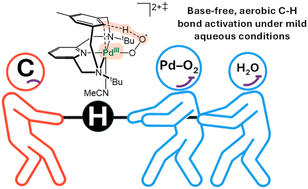
Recent reports have increasingly documented palladium-catalyzed C–H bond functionalization reactions involving high-valent PdIII and PdIV intermediates, yet these transformations often depend on strong oxidants and external bases. Herein, we report a series of PdII complexes [(pRN3CH)PdII(MeCN)](BF4)2, supported by a tetradentate pyridinophane ligand, that undergo aerobic C–H bond activation under mild aqueous conditions without the need for an added external base to generate isolable PdIII complexes. In this transformation, O2 serves as both an oxidant and proton acceptor, eliminating the need for an exogenous base. Mechanistic and computational studies are consistent with a rate-limiting concerted metalation–deprotonation (CMD) pathway involving a key Pd–O2 species that promotes C–H bond activation. Notably, the presence of water in the solvent mixture and slightly elevated temperatures enhance reactivity and lead to quantitative formation of the PdIII product, improving its synthetic utility. Overall, this study establishes a C–H bond activation pathway at high-valent palladium centers that proceeds without added external base, with O2 serving as both oxidant and internal proton acceptor. These findings provide key insights into high-valent palladium reactivity and lay a mechanistic foundation for sustainable aerobic oxidation strategies.
 Please wait while we load your content...


