


 PLATFORM UPDATE:

d-Orbital modulation of high-entropy sulfides with amorphous/crystalline heterostructures for simultaneous hydrogen production and sulfur recovery

Abstract
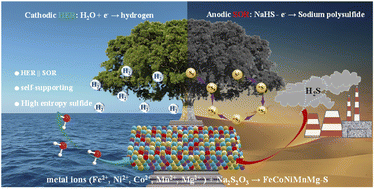
Replacing the anodic oxygen evolution reaction (OER) with the sulfur oxidation reaction (SOR) presents a promising strategy for energy-saving hydrogen production and simultaneous treatment of sulfur-rich wastewater. However, the adsorption and accumulation of sulfur intermediates on catalyst surfaces often lead to active-site poisoning and structural corrosion, severely hindering practical implementation. Herein, we report a novel amorphous/crystalline high-entropy sulfide (FeCoNiMnMg–S) heterostructure synthesized via a facile room-temperature corrosion method. This amorphous/crystalline structure not only enhances charge transfer at the heterointerface but also triggers electronic rearrangement of the M-site d-orbitals. This facilitates electron transitions from the t2g orbitals to the eg orbitals, achieving a half-filled electronic configuration that optimizes the adsorption of sulfur intermediates at the M-site. Benefiting from this electronic structure modulation, the catalyst exhibits exceptional bifunctional activity for both the hydrogen evolution reaction (HER) and SOR, achieving an ultra-low cell voltage of only 1.04 V to deliver 1000 mA cm−2, along with outstanding operational stability over 200 hours at high current density. This work provides a new paradigm for designing highly efficient and robust electrocatalysts that enable sustainable hydrogen production and synchronous sulfur recycling in a single system.
 Please wait while we load your content...


