


 PLATFORM UPDATE:

Interrogating the synthetic likelihood of metal–organic frameworks: a digital discovery perspective
 a
and
Jianwen
Jiang
*a
a
and
Jianwen
Jiang
*a
Abstract
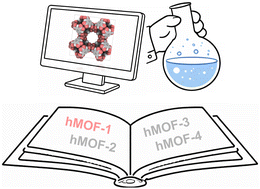
Digital discovery of metal–organic frameworks (MOFs) has advanced rapidly, driven by the tremendously large number of experimentally synthesized and computationally designed structures, high-throughput screening, and artificial intelligence. Yet a fundamental bottleneck remains: many hypothetical MOFs (hMOFs) may never reach a chemical laboratory. This gap has rendered the synthetic likelihood of MOFs a central challenge in translating digital MOF discovery into experimental synthesis and test. In this perspective, we provide an overview of recent progress in interrogating the synthetic likelihood of MOFs. First, thermodynamic analysis, focusing on free energy as a physically grounded metric for assessing synthesizability, is presented. Then, emerging data-driven heuristics, such as synthetic scores, classification models for synthesizability prediction, and machine-learning methods for predicting synthesis conditions directly from atomic structures, are discussed. Finally, we offer an outlook on future directions, including scalable free-energy calculations, synthesis-aware inverse design, and unified databases that incorporate both successful and failed synthesis attempts. It is highly anticipated that integrating these advances will transform MOF discovery from performance-driven screening into synthesis-informed design, thereby accelerating the realization of computationally designed structures in experiments.
- This article is part of the themed collection: 2026 Chemical Science Perspective & Review Collection
 Please wait while we load your content...


