


 PLATFORM UPDATE:


Decoding cryptic defluorinases through a latent generative sequence landscape
 †a
Sydney S.
Barnes,
†a
Cheyenne
Ziegler,
†b
Jose Alberto
de la Paz,
b
Nikita
Kvasovs,
a
Faruck
Morcos
*bcde
and
Sheel C.
Dodani
*a
†a
Sydney S.
Barnes,
†a
Cheyenne
Ziegler,
†b
Jose Alberto
de la Paz,
b
Nikita
Kvasovs,
a
Faruck
Morcos
*bcde
and
Sheel C.
Dodani
*a
Abstract
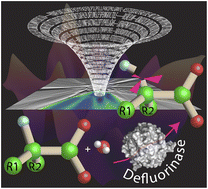
The special nature of the fluorine atom imparts remarkable strength and unique physical properties to chemical bonds. Unlike man-made fluorochemicals, fluorinated natural products remain rare due to low bioavailability and toxicity of fluoride. Despite this, defluorinases have evolved in nature to cleave carbon-fluorine bonds, with the hydrolytic fluoroacetate dehalogenase being one of the most well-characterized examples. These enzymes are of fundamental interest and hold unrealized biotechnological potential, yet the scope of this unique chemistry remains underexplored in the biosphere. Here, we trained and applied a machine learning-based framework, termed latent generative landscapes (LGLs), to map the functional sequence space of the α/β-hydrolase superfamily. This approach identified 3014 putative defluorinases that were previously not annotated or plausibly misannotated. Experimental validation of selected candidates led to the reclassification of five novel defluorinases, all exhibiting high thermal stability (Tm > 70 °C) and diverse catalytic efficiencies with conserved enantioselectivity on the model substrate 2-fluoro-2-phenylacetate. Notably, the enzyme A0A4Z0BVY8 exhibited 2.7-fold greater defluorination activity than the current state-of-the-art enzyme Q6NAM1. Our results establish that LGL modeling is a powerful strategy to decode cryptic carbon–fluorine bond chemistry in nature, enabling the future discovery and engineering of defluorination biocatalysts.
- This article is part of the themed collections: 2026 Chemical Science HOT Article Collection and Celebrating Professor David O’Hagan’s Retirement, Organofluorine Chemistry
 Please wait while we load your content...


