


 PLATFORM UPDATE:


A highly stable, planar thiophene-fused triarylborane as a new building block for semiconductor polymers

Abstract
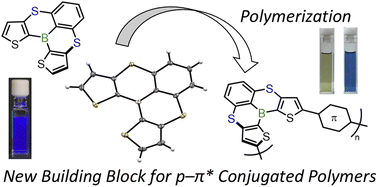
π-Conjugated compounds containing tricoordinate boron atoms have attracted significant attention because of their unique properties, including low-lying LUMO energy levels, extended π-conjugation, and high Lewis acidity. In particular, planarized triarylboranes have been extensively studied in recent years owing to their high chemical stability and excellent photoluminescence properties. Despite exhibiting potential for strong intermolecular interactions and superior semiconducting performance arising from the absence of bulky substituents, the synthesis of p–π* conjugated polymers using such planarized units as building blocks, along with the evaluation of their semiconducting properties, remains a significant challenge that has not yet been addressed. In this study, we report the synthesis of DTTB, a new planarized triarylborane featuring benzene and thiophene rings fused via boron and sulfur atoms. DTTB represents a versatile building block that combines good chemical stability with a perfectly planar geometry, facilitating intermolecular π–π stacking as confirmed by X-ray crystallography. Furthermore, the fused thiophene rings allowed for facile deprotonation at the α-positions, enabling the first integration of planarized triarylborane units into p–π* conjugated polymers. The synthesized p–π* conjugated polymers exhibited ambipolar transport behavior with enhanced carrier mobilities compared to non-planarized analogs. This work provides a conceptual advance by demonstrating that the rigid planarization of triarylborane units is a superior strategy for enhancing the semiconducting performance and thermal stability of p–π* conjugated materials, offering a design strategy for polymer semiconductors.
 Please wait while we load your content...


